
Another hectic week, and definitely had a tough time motivating myself early in the week. Ideally, I would love to be able to wake up early to get my workouts done before work, but I cannot seem to break the cycle of waking up right before work, then not being able to log off and get my workouts in until very late at night. This usually means I am eating dinner around 11pm-12am and not getting to bed until closer to 1am.
Monday 12/7
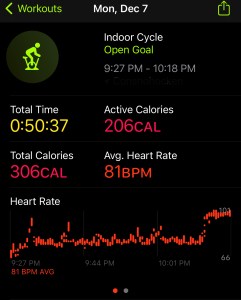
I was supposed to do an endurance 2 mile run, but I was exhausted and just wanted to get my rings closed, so I hopped on the bike. Unfortunately, I was so tired that I wasn’t able to get my HR high enough, so I ended up biking for 50 minutes and still could not close my 30 minute exercise ring. I therefore hopped onto the treadmill and walked for about 25 minutes. One might say I should have just run. However, my form has always suffered when I am tired, so it was still a smart move to bike and walk. Walking would have closed my ring quicker, but we only have one treadmill, and my wife suffers the same insane work schedule.
- Lesson 1: If you are tired and still want to get in a workout, make sure to do something that will not negatively impact you because you are tired. For me, running form suffers, which can lead to injury. Likewise, doing a HiiT or strength workout, I will have the same issue. My go-to is biking on my trainer.
- Lesson 2: Being obsessed with closing rings (Apple Fitness) or completing daily goals (Garmin/FitBit/Polar, etc.) are fine. But make sure if you are going to complete them, you do it safely. The last thing you want it over-training or improper training that will injure you and possibly cause long-term issues.

Tuesday 12/8
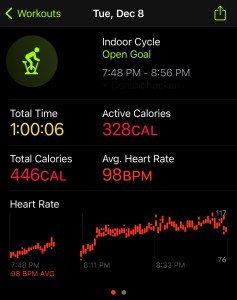
Nike Run Club called for a 4 x 800m interval session today. No change from Monday; exhausted and hopped on the trainer. I was shooting for another relaxed pace, but tried to go a little harder so I wouldn’t be on the bike so long. I guess I was so tired I didn’t realize how slow I was going. Therefore, I ended up biking for an hour, with me ramping things up about 1/3 of the way in.
Wednesday 12/9
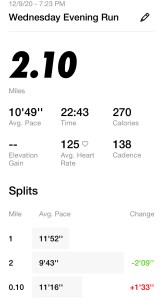
The plan called for a rest day. However, I was feeling motivated and not as exhausted from work. Did my usual NTC Wake-Up Warm-up. This is still one of my favorite warm-up routines that is only about 10 minutes long. No matter how tight and sore I am, this seems to really loosen me up where I need it the most; hips, lower back and shoulders. I still find the P90X3 Cold Start to be one of the best warm-up routines I have ever done, but that takes a bit longer.
Once I got my warm-up done, I decided I would do my Monday run, which was supposed to be an endurance 2 miler. Instead of doing an endurance pace, which is similar to an easy run, I did a tempo 2 miler. As always, I am doing the Galloway method with run/walk, where I do 2 minutes running, walking 30 seconds. The run felt really good, but I am still surprised how high my HR gets when I run now. Well, it’s high for me, but normal range based on my age and physical conditioning.
- Lesson 1: HR training isn’t necessarily useful for most people. It is typically used more for athletes to fine-tune or shave a few more seconds off their times. Focus more on consistency when it comes to form and your workout schedule. You can then start focusing on pace and then look into other metrics to help yourself improve or meet your goals.
- Lesson 2: HR is still a good guide to make sure you aren’t overdoing your training. I am not an expert on hearth rate, so I usually turn to sources that do their homework. My go-to is Runner’s World and here a link to an updated HR article. As a quick note, I am not affiliated with them. I just have been reading the magazine and website for over 20 years now.
Thursday 12/10
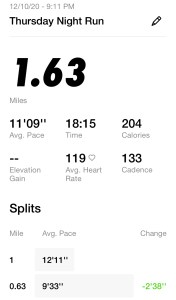
My plan called for a 4 x 400 m interval session today. That’s exactly what I did! Did my NTC warm-up, then hopped on the treadmill for my intervals. As a quick note, when I am doing my intervals on the treadmill, even though I am doing Galloway, I will complete the full interval with running only. For example, I am usually doing my intervals at 7 – 7.2 mph (8:34 to 8:20 pace). This means that my 400 m split will always be over 2 minutes. If I were running outside, I would follow Galloway still; however, it’s a bit tough on the treadmill because you cannot adjust the speed that quickly. So, for a better training experience, I do the whole interval running. I do this for my 800s as well.
- Lesson 1: If you are following Galloway, and you want to do distance intervals instead of time intervals, you have a couple of options.
- Option 1: Use your Galloway splits for the distance no matter what. Again, this is much easier when outdoors, but can still be done on the treadmill.
- Option 2: Run the entire interval.
- Option 3: If you cannot run the entire interval yet, you can change your Galloway splits to coincide with the distance you are running. This can be difficult unless you have a lot of data or use a calculator tool. Unfortunately, there are not any good free ones I could find. I am working on creating a free one though, so stay tuned!
- Lesson 2: Galloway wasn’t necessarily intended for the way I am training with this plan. I am doing somewhat of a hybrid model. If you want to do interval training and use Galloway, you will want to use short run and increase walk splits, with you increasing your pace for the run segments. For example, if you are running at a 10 min/mile pace for a 2 min run split, then you might want to try doing a 9:30 pace for a 1 min run split, but instead of 30 seconds walk, you might want to increase to 1 min, maybe even 2 min.
Friday 12/11
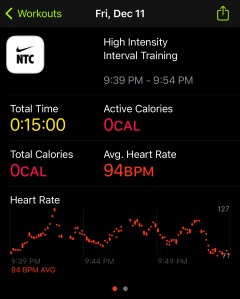
Today was an NTC day. As you know, I have been pretty bad at doing my NTC workouts during this running plan. However, I was successful this time! I did the NTC Basic Burn workout. I still did my NTC Wake-up Warm-up first though. I have learned that doing any workout other than biking or yoga, if I do not do my stretching warm-up, I have a chance of injuring myself, or at the very least my recovery takes much longer.
Saturday 12/12
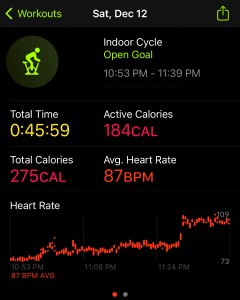
NRC had me set for a 4 mile long run. However, it was cleaning day so I ended up biking. With how busy the day was, I ended up biking super late as well, and was really exhausted. I biked for 45 minutes, ramping up the intensity the last 15 minutes. Overall it felt good to loosen up from hours of cleaning. Plus, this always helps my recovery the following day so my back isn’t bugging me as much.
Sunday 12/13
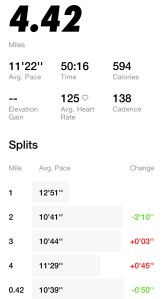
Since I cleaned and biked on Saturday, I moved my long run to today. I did the 4 mile long run as prescribed. Some strange things I am starting to notice while using the Nike Run Club watch app is that the accuracy seems to be getting worse each run. One of my gripes with the app is that you cannot calibrate. The only recommendations I have found is the same thing for the native Apple running app; run outside for at least 20 min. If the accuracy keeps getting worse, I may have to do that. But, for now, regardless of my what my watch says for distance, I make sure I am hitting the correct mileage on my treadmill. To put this in perspective, my run was supposed to be 4 miles. The final treadmill distance showed as just over 4.1 miles, but my watch said 4.42 miles. That’s over a 1/4 mile off!
- Lesson 1: If you are indoor training and you religiously use your watch stats for trending and improving, as much as I like Apple and Nike, I would say you have 2 options:
- 1) Use a running app on Apple Watch that you can calibrate at the end of your run, and use the that data, and NOT the Apple Fitness data for metrics.
- 2) Use a fitness watch that can be easily calibrated after your run. For example, Garmin is typically garbage for treadmill accuracy unless you are using sensors. However, it lets you calibrate after your run, and then the stats are adjusted accordingly when you review. From my experience, Polar is one of the more accurate watches for treadmill tracking without added sensors. FitBit isn’t too bad either.
- Lesson 2: If you are using a gym treadmill or your personal treadmill is more than a few years old, you should take the accuracy on the treadmill with a grain of salt.
- Gym Treadmill: Technically speaking, a gym treadmill should be serviced every 6 months to ensure the best possible accuracy. However, there are few gyms that do this, with most gyms only servicing when the treadmill actually breaks down. Ask the front desk at the gym when their treadmills were last serviced.
- Personal Treadmill: For personal treadmills, the accuracy can start to shift after a couple of years or so if you have considerable usage. Heavy usage will shorten that time, but not many people put mileage on their own treadmill that would rival a gym treadmill, unless you have a multiple family members using the same treadmill daily. I am not usually a fan of warranties, but if you can get a service warranty for your treadmill, it will definitely save you some money if you really care about or need that accuracy. Or, you can live with the results like I typically do. In the grand scheme of things, it’s not a big deal. The treadmill is usually going to be much more accurate than your watch, so going with the treadmill is fine. If you rely on your treadmill being accurate, then you will want to get it serviced every 12-18 months, or at least that is what I recommend. You can do 6 months, but I think that is a bit overkill for personal treadmills.
- I have mostly used ProForm treadmills and my last one I had for over 10 years, and the accuracy didn’t really get too bad during that entire time. My new ProForm is a bit over 2 years old and isn’t really showing any change in accuracy, so I probably will wait at least another year or two before I recheck the accuracy. Manually testing accuracy is annoying, but worth it if you want to know and/or care.
 A techie's fitness life