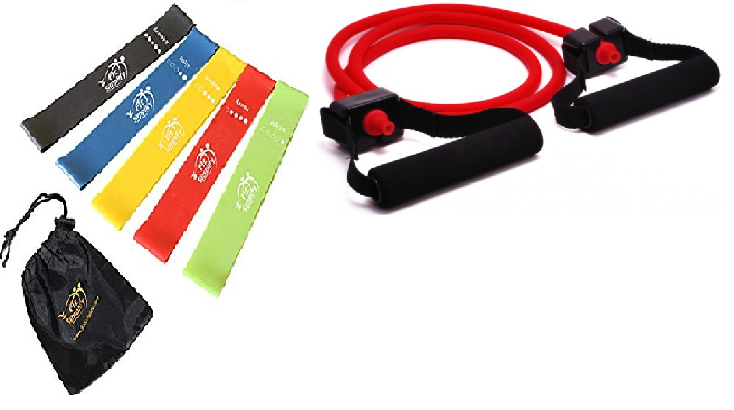
 As you can see from the title, I “might” be a fan of resistance bands. I also don’t use them enough, but that’s my fault. A common tool for most physical therapists, trainers or rehab specialists are resistance bands. Resistance bands and resistance training has been around as far back as I can remember.
What is Resistance Training
Resistance training can be referred to as a couple things; elastic resistance training or variable resistance training. With the use of bands, you are creating a variation in the load to your muscles via some sort of range of motion routine. I will highlight a few of those later.
Some of the many reasons people use resistance training is to improve range of motion, combat joint issues, improving your weighted workouts, and physical therapy.
For me personally, I have used resistance training to help me get to a point where I can do specific exercises. For example, I could not do pull-ups for the longest time, and even with using pull-up assist, I just couldn’t seem to progress. Therefore, I used resistance bands to build up the specific muscles I needed for doing pull-ups. After a few weeks of this, I was not only able to many more assisted pull-ups, but also regular pull-ups.
Types of Bands
There are two types of resistance bands; flat and tubed. I recommend you get both, as some exercises are a lot easier with one vs. the other. Flat bands are latex ribbons that you can either buy different sizes, or get spools and create your own lengths. If you ever go to physical therapy, they typically have the spools and will cut a length that suits the person getting the PT. Tubed bands are like bungee cords, with handles on each end. Again, they vary in length. Personally, I use the below bands (I have both flat and tubed).


Fit Simplify Resistance Band Set 12 Pieces with Exercise Tube Bands, Door Anchor, Ankle Straps, Carry Bag
Some Flat Band Exercises
One of my favorite routines is Glute Kick-back. This involves a flat band, where you are on your hands and knees, with the band looped around one of your ankles and then your opposite foot. You lift your leg (one with the band on the foot) straight back to it’s fully extended. Then slowly bring your leg back down. Repeat on the opposite side.
Another one I like a lot is Glute Bridge. It’s the same as a normal Glute Bridge, but with the flat band around your thighs. Next up is lateral lunge. Again, this is doing a normal lateral lunge, but with the flat band around both ankles. One of my favorites is lateral walks. For this one, the flat band is on your ankles and then you do normal lateral walks. Another one I like a lot, and have used in PT and for my hip issues, is Lying Lateral Leg Raise. For this one you will have the flat band around both ankles again.
Some Tubed Band Exercises
One exercise I like a lot is wood choppers. You attach the tube band to a door, around the top hinge, and perform a normal wood chopper routine. You can also to X
Upward row is another good one. For this, you will have the tubes under your feet, and then have the opposite handle end in each hand. Basically it will look like you have an X in front of you. I also like thrusters; which are a combination of front squat and overhead press. For this one, you will have the tube under your feet, but instead of an X with the wood choppers, they will just go straight to each hand.
There are tons of other routines for both band types. In addition, most normal strength and movement routines can be done with bands, so the possibilities are almost limitless. And to top things off, you can bring your bands anywhere you go, making it easy to workout on the go. Below are some books with great exercises that I have used. Enjoy!
Some Reads
| Injury Rehab with Resistance Bands: Complete Anatomy and Rehabilitation Programs for Back, Neck, Shoulders, Elbows, Hips, Knees, Ankles and More – This is a book I really like and used when I had my stress fracture and needed rehab. |   |
| Resistance Tubing Exercises Poster/Chart -Back/Legs/Biceps/Chest & Triceps Laminated – This is a great reference tool that you can hang up at your home which has all of the major tube band exercises. I like it because it allows you to just pick some routines (or all) without having to plan anything out or look up specific workouts to do. |   |
| HOME WORKOUT CIRCUIT TRAINING: 6 week exercise band workout & bodyweight training for fat loss, strength and muscle tone – This is another book I had picked up after my stress fracture. I had enjoyed the band use in my rehab that I figured I would try out an actual training plan based on bands. |   |
| Strength Band Training – I really like this book just for the sheer amount of band workouts it has. When I was building my own routine, this really was really helpful. |   |
 A techie's fitness life