Not sure I could have survived P90X2, marathon, or Ironman training without my trusty foam roller. But as I was telling people about how much I loved foam rolling, I started having people question why I was using it and said I could hurt myself. Even my friend who is a PT recommended not using a foam roller. Well, I don’t take anyone’s word without doing some research, especially since I never saw any ill-effects.
What are Foam Rollers?
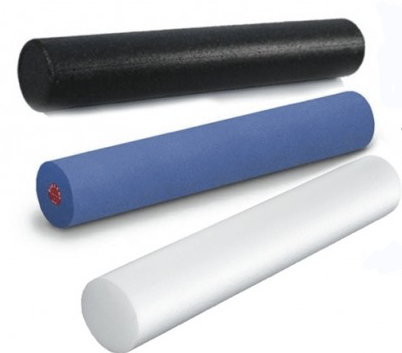
Typically, a foam roller is moderately hard foam shaped into a cylinder of varying lengths. One of the main uses is self-massage, also known as self-myofascial release. The other use is for fitness.
In regards to the self-massage, the foam roller allows for focused pressure on tight spots and trigger points. The pressure is supposed to be light to moderate, but typically should be light. Applying this pressure and “rolling” over the points allows for release in the tension. Does this work? We’ll get to that in a bit.
As with almost any fitness-related tools, a foam roller can also be used for fitness routines. You will typically see yoga and Pilates moves that incorporate a foam roller. There are also a variety of core workouts that can be modified with a roller as well.
Types of Foam Rollers
As I noted, there are many different lengths, as you might only need a shorter roller for arms and legs, but maybe a longer one for using along the spine. Aside from lengths, there are different shapes as well. The overall shape is still a cylinder, but might have ridges, bumps, or be a half-cylinder. This allows for even more focused pressure on trigger points. There are also varying densities of foam (or firmness). As I already noted, they are typically moderately hard, or standard. There are also soft and firm. Soft provides a little more squish, but not like you would get in a swim noodle. Firm has no give and feels like you are on a hard surface.
The Benefits to Foam Rolling
The main benefit is the self-massage. Personally, there is nothing more relaxing than foam rolling after a long run or my body is really sore from a workout. The intent is to help relieve muscle tension and knots, as well as provide pain relief. Well, pain relief after the pain you go through in foam rolling. Anyone who has used a foam roller knows that putting pressure on a knot is amazingly painful. However, after the pressure and rolling, the relief most feel after is amazing.
Another benefit to foam rolling is an increase in core strength. Once you try out some basic rolling techniques, you will see that you can’t always just be sitting on the floor and relaxed; you will need to engage some muscles to put you in the proper position to roll properly. This also leads to the next benefit of improved flexibility and faster recovery. I cannot count how many injuries come from muscle tightness and a lack of flexibility.
The Risks of Foam Rolling
So foam rolling sounds awesome, right? How could it be bad. In my opinion, it’s not bad at all. However, like anything, done incorrectly can have negative results. The most common impact from improper use it muscle damage.
Another negative, which I argue is really just not listening to your body, is working out tight and then thinking foam rolling will fix any problems afterwards. This really goes back to not warming up correctly or at all. If you are tight and don’t address that ahead of your workout, then you are at a higher risk for injury. Foam rolling after the fact won’t prevent that.
Next is foam rolling an injury. A foam rolling session shouldn’t really be long; if you are focusing on a single spot for more than 10 minutes, then you are probably dealing with a larger issue that needs a professional to check it out. Personally, I have never spent more than a few minutes on any one spot. If you are rolling for exercise, your session may be much longer though. However, you are focusing on many areas, so this is a bit different.
A lesser issue is bruising. This is caused from either too much pressure on a spot or using a roller that is too firm.
Finally, another risk is that you could feel worse after rolling. This is similar to the bruising issue though. It typically means you are applying too much pressure. However, this is more common in areas that are bonier, like your lower back and spine. Just exercise caution.
Keep on Foam Rolling
As you can probably see, you should keep foam rolling. It’s very helpful and a great tool. It is however, no replacement for a medical professional if you are injured. And, as with any activity you do, you should always make sure you doing things correctly. Enjoy the best pain ever…I mean, enjoy your foam rolling.
Some Reference Material and Gear
| Foam Roller / Myofascial Release Chart – This is a great great reference guide for basic moves to target the most common sore areas. |   |
| Foam Roller Workbook, 2nd Edition – This is a new release and has a ton of great workouts and basic stretches included. It has great pictures to follow and any level can use this. I don’t usually recommend new releases until I have used them more, but this one was really good. I was a fan of the first edition, and this is even better. |   |
| P90X2 – As mentioned, I had done P90X2 and it has amazing foam rolling routines. I could not have completed the program without it. If only the P90X3 Cold Start was around back then. That coupled with the foam rolling would have been so awesome! |   |
| Moderate Density (Standard) Foam Roller – The high density rollers are usually the first ones that appear when searching, and since you probably want to start with a standard one instead, figured I would provide an example of one. Shop around though and find the least expensive one…foam rollers are not a “pay what you get for” good. |   |
 A techie's fitness life